









YouTube Statistics 2026: Key Trends, Data, and Insights


YouTube statistics start with the humble beginnings in 2005 with a single video titled Me at the Zoo. As of 2026, YouTube is more than a video-sharing platform. The platform genuinely influences everything from entertainment trends to marketing strategies.
YouTube is estimated to have over 2.7 billion monthly users worldwide. It also offers creators, brands, and marketers unmatched opportunities to engage with a global audience on any topic.
Ready to Grow Your YouTube Channel Fast? Boost real views, watch hours, and engagement with SocialPlug.io today!
Social Media Trends
Check out the platform’s very first video: Me at the Zoo
Understanding YouTube demographics and user statistics is crucial for creators and brands seeking to target the right audience. Today, we will talk about all the essential YouTube stats and trends to help you understand its impact and how you can utilize its full potential.
YouTube Statistics (Our Picks)
| Key Numbers |
|
| Most Shocking YouTube Statistics |
|
YouTube User Growth
The increasing numbers show how YouTube continues to attract new users globally, becoming a staple of internet culture.
- ▶ Nearly half of all internet users worldwide access YouTube monthly (Source: DataReportal).
- ▶ YouTube ranks as the 2nd most visited website in 2026, second only to Google (Source: Semrush).
Monthly Active Users (MAU)
YouTube now has over 2.7 billion monthly active users, making it one of the most popular platforms in the world. These are people who log in at least once a month to watch videos, like, comment, or subscribe. Check the numbers below:
| Platform | Monthly Users |
|---|---|
| YouTube | 2.7B |
| 2.9B | |
| TikTok | 1.2B |
| 2B |
The YouTube demographic shows that the majority of users are aged 18–34, which is a prime audience for content creators and advertisers.
Daily Active Users (DAU)
Over 120 million people in the U.S. watch, share, and interact with videos every day consistently. These daily active users are responsible for a massive watch time of over 1 billion hours. (Source: Market.us)
Monitoring daily activity is crucial because it shows how habit-forming YouTube is and helps creators understand when their audience is most engaged. These view stats are essential for planning content and ad campaigns.
Growth Rate Over the Years
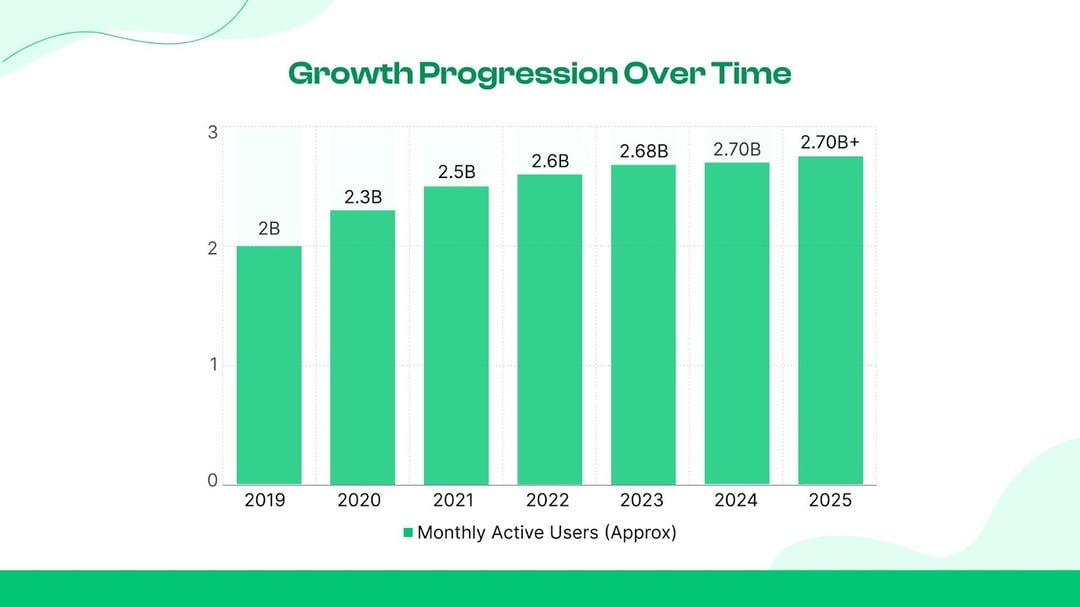
| Year | Monthly Active Users (Approx) |
|---|---|
| 2019 | 2.0 billion |
| 2020 | 2.3 billion |
| 2021 | 2.5 billion |
| 2022 | 2.6 billion |
| 2023 | 2.68 billion |
| 2024 | 2.70 billion |
| 2025 | 2.70 billion+ |
Although growth has slowed compared to early years, YouTube continues to add millions of new users each year. These view stats indicate the platform’s ongoing dominance and global appeal.
Mobile vs Desktop User Growth
- ▶ The majority of total YouTube monthly watch time, often estimated at 40–70%+ of all watch time coming from mobile. (Source: Measure Studio)
- ▶ Desktop use has grown much more slowly, with far fewer monthly active users compared to mobile.
Logged‑in vs Logged‑out Viewers
Official platform‑wide data for logged‑in vs logged‑out users is not comprehensively published by YouTube. You can get the data from YouTube Analytics.
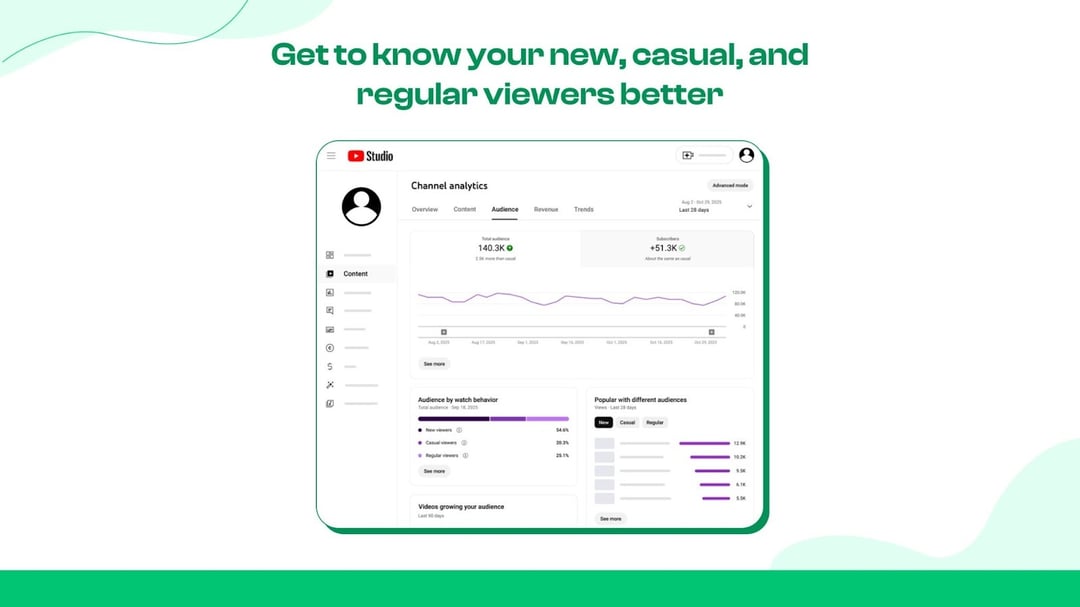
A large majority of Daily active users and Monthly active users log in with Google accounts to access personalized recommendations and subscriptions. Logged‑out viewers still contribute significantly to overall view counts and watch time.
Most public YouTube user statistics focus on logged‑in users. True viewer counts (including logged‑out audiences) may be even higher than the reported MAU figures suggest.
Consider buying YouTube subscribers for an instant boost!
Demographics: Who Uses YouTube?

Let’s understand the demographics now.
YouTube Users By Gender
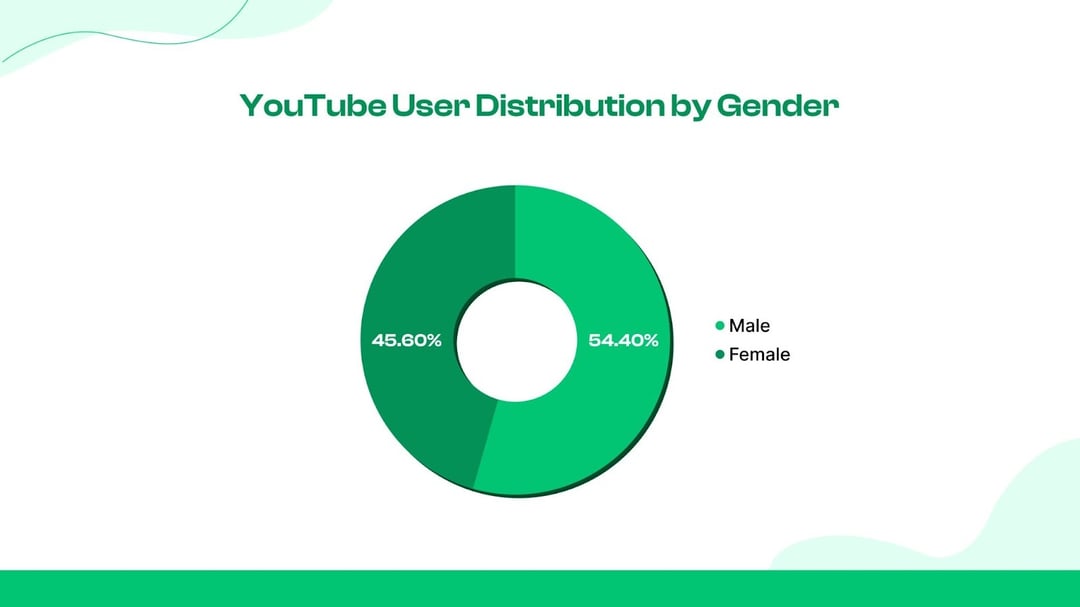
- ▶ 54.4% male and 45.6% female globally (Source: Statista).
- ▶ In the USA, 51.4% of YouTube users are female, slightly reversing the global trend.
YouTube Users By Age
| Age Group | Percentage |
|---|---|
| 18–24 | 15.5% |
| 25–34 | 21.3% |
| 35–44 | 17.5% |
| 45–54 | 12.5% |
| 55–64 | 9.2% |
| 65+ | 9.2% |
Over half of YouTube users fall within the 18–34 age range, making it an ideal platform for brands targeting Millennials and Gen Z.
Check out this YouTube Marketing Case Study here.
YouTube Users By Income Level
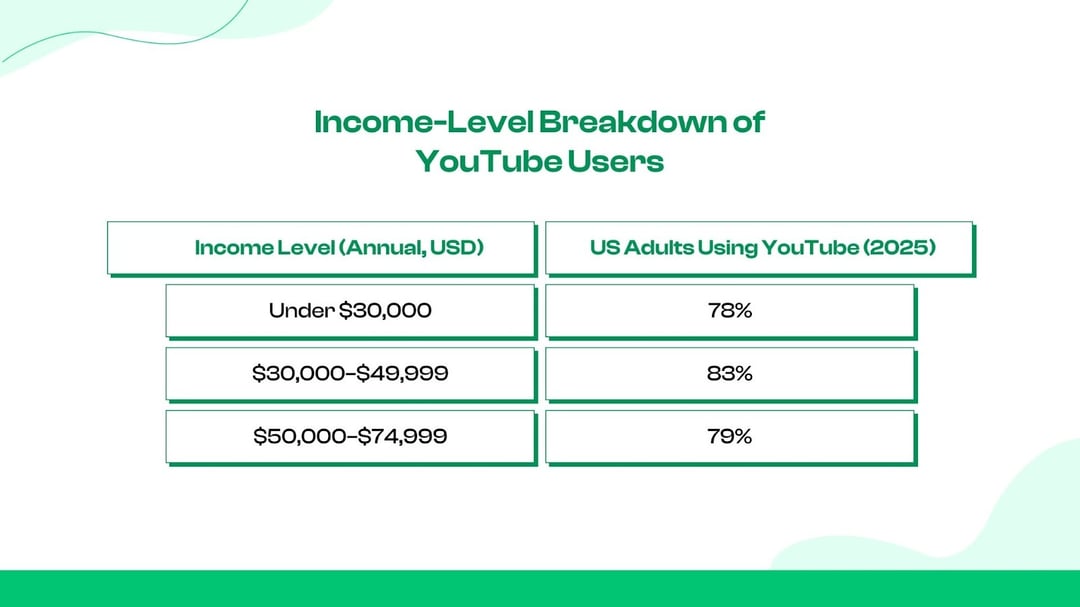
Higher-income users are particularly prominent, likely due to better access to devices and the internet. (Source: Pew Research Center)
YouTube Users By Education Level
- ▶ 70% of adults with a high school education or less use YouTube.
- ▶ 89% of those with more than a college education use the platform.
Family & Kids Usage Trends
Studies show that about 35% of kids under 12 watch YouTube daily, often co-viewing with parents.
Toddlers and older kids spend an average of 90+ minutes per day on YouTube and YouTube Kids. This makes family content a major driver of view stats and engagement.
Parents often prefer YouTube Kids for age-appropriate videos. Older children may use the main YouTube platform.
Usage Insights: Devices and Behaviors
Ever wonder why some videos go viral while others struggle to gain traction? It’s all about understanding audience psychology.
- ▶ The Right Thumbnails: Bright, enticing thumbnails trigger curiosity and boost click-through rates.
- ▶ Storytelling Appeal: Viewers are drawn to narratives that evoke emotion, whether humor, inspiration, or suspense.
- ▶ The Zeigarnik Effect: Leaving something unresolved (like “wait until the end”) keeps viewers engaged longer.
By using psychological principles, creators and brands can craft content that resonates on a deeper level.

Viewing Habits
The average YouTube session lasts 40 minutes. (Source: touchstorm)
| Device Type | Share (%) |
|---|---|
| Mobile | 63% |
| Connected TV | 14% |
| Desktop | 12% |
| Tablets | 8% |
| Consoles | 3% |
| Total | 100% |
YouTube’s Top 5 Most Subscribed Channels
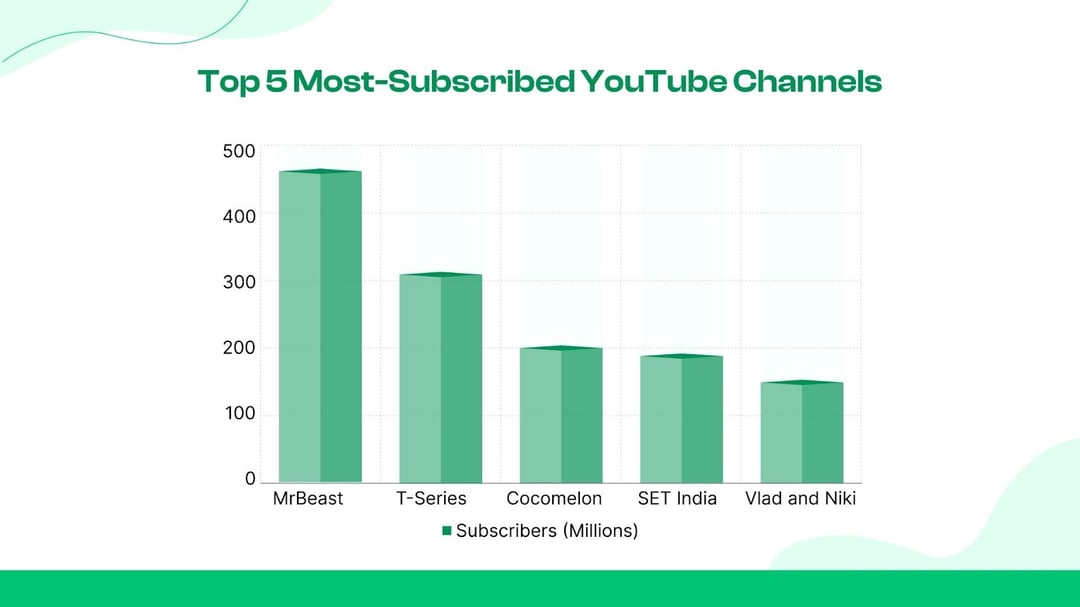
| Rank | Channel | Category | Subscribers (Millions) |
|---|---|---|---|
| 1 | MrBeast | Entertainment / Philanthropy | 462 |
| 2 | T-Series | Music / Bollywood | 309 |
| 3 | Cocomelon | Education / Animation | 200 |
| 4 | SET India | Entertainment (Hindi) | 188 |
| 5 | Vlad and Niki | Kids' Entertainment | 149 |
Top 10 Most-Viewed Videos on YouTube
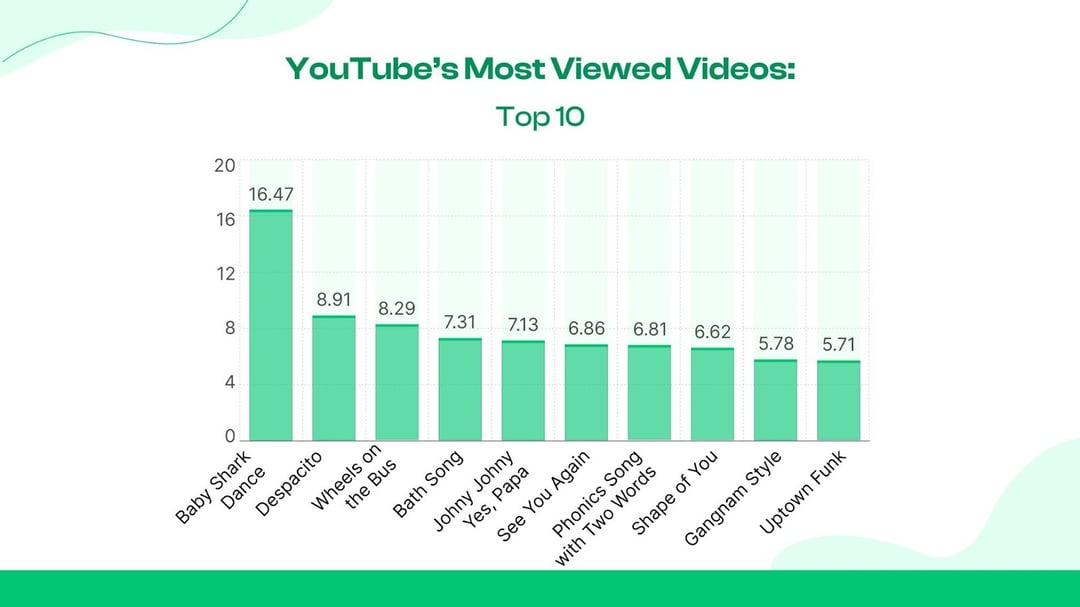
| Rank | Videos | Channel | Views (In Billions) |
|---|---|---|---|
| 1 | Baby Shark Dance | Pinkfong Kids' Songs | 16.47 |
| 2 | Despacito | Luis Fonsi ft. Daddy Yankee | 8.91 |
| 3 | Wheels on the Bus | Cocomelon | 8.29 |
| 4 | Bath Song | Cocomelon | 7.31 |
| 5 | Johny Johny Yes, Papa | LooLoo Kids | 7.13 |
| 6 | See You Again | Wiz Khalifa ft. Charlie Puth | 6.86 |
| 7 | Phonics Song with Two Words | ChuChu TV | 6.81 |
| 8 | Shape of You | Ed Sheeran | 6.62 |
| 9 | Gangnam Style | Psy | 5.78 |
| 10 | Uptown Funk | Mark Ronson ft. Bruno Mars | 5.71 |
| Rank | Videos | Artist | Days to 1B |
|---|---|---|---|
| 1 | Hello | Adele | 87.4 |
| 2 | Despacito | Luis Fonsi | 96.5 |
| 3 | Shape of You | Ed Sheeran | 97.4 |
| 4 | Mi Gente | J Balvin & Willy William | 102.7 |
| 5 | APT | ROSÉ & Bruno Mars | 105.0 |
| Video | Artist | 24 Hour Views |
|---|---|---|
| Butter | BTS | 108.2 Million |
| Dynamite | BTS | 101.1 Million |
| GTA VI Trailer 1 | Rockstar Games | 93.0 Million |
| Pink Venom | BLACKPINK | 90.4 Million |
| Category | Engagement Rate |
|---|---|
| Humor / Gags | 48.2% |
| Entertainment | 39.1% |
| Pets & Animals | 27.0% |
| Food / Restaurants | 23.5% |
Average Time Spent on YouTube
On average, people spend 49 minutes per day watching YouTube. This includes short clips, long videos, tutorials, and music, contributing heavily to total YouTube monthly watch time.
Sessions per Day
Most users open YouTube 1–2 times per day, though some check multiple times, especially during breaks, evenings, or weekends. Each session adds to the overall view stats and helps maintain high numbers of Daily active users.
Second-Screen Viewing Behavior
Many users now watch YouTube while using another device, such as scrolling social media, texting, or browsing the web. This second-screen behavior boosts view stats because videos keep running even when users multitask.
Younger audiences are especially prone to second-screening, which makes it a key part of the YouTube demographic and overall YouTube user statistics.
Background Play & Multitasking
Another growing trend is background play, where users let videos, music, podcasts, or tutorials play while doing other things.
Even if users aren’t actively watching, these views count in view stats and contribute to Daily active users and total YouTube monthly watch time.
YouTube Content Consumption Patterns
Short‑form content like YouTube Shorts gets massive daily views and quick engagement, especially for mobile users.
Long‑Form vs Short‑Form Consumption
- ▶ Short videos tend to receive 2.5× more engagement than long‑form content,
- ▶ Formats under 90 seconds retain around 50% of viewers on average.
- ▶ Long‑form videos still make up the majority of watch time on YouTube
- ▶ Longer sessions help creators build deeper connections and loyalty with audiences.
This means both formats are important: short‑form content for reach and buzz, and long‑form content for keeping viewers watching.
Live Streams vs Pre‑Recorded Videos
Live streams significantly outperform pre-recorded videos in "stickiness."
| Metric | Live Streams | Pre-recorded |
|---|---|---|
| Average Watch Time | 25.4 minutes per session | 19.0 minutes per session |
| Engagement Rate | 10%–20% higher than VOD | Industry baseline |
| Comments/Chat | High (Real-time interaction) | Moderate (Delayed feedback) |
| Preference (Gen Z) | 42.8% watch weekly | High (but shifting to Shorts) |
Livestream viewers tend to contribute significantly to total view stats and YouTube monthly watch time because sessions often last many minutes or even hours.
Educational vs Entertainment Content
The difference between Educational and Entertainment content on YouTube has blurred into a hybrid often called "Edutainment”.
People come to YouTube for both learning and entertainment. Entertainment genres like music, comedy, and lifestyle remain among the most viewed, together accounting for a large share of total views.
Educational videos, DIY tutorials, and how‑to guides are strongly growing, with year‑over‑year increases in view stats showing that audiences increasingly use YouTube for learning as well as leisure.
Because educational content often keeps viewers watching longer, it contributes valuable Watch Time & Audience Retention metrics that help boost discovery through the algorithm.
| Educational | Entertainment | |
|---|---|---|
| Primary Goal | Solving a problem / Skill acquisition | Relaxation / Escapism / Thrill |
| Average CPM | High ($9.00 – $15.00) | Low ($1.00 – $3.00) |
| Viewer Intent | Active (Searching for specific info) | Passive (Browsing / Algorithm-led) |
| Content Lifecycle | Evergreen (Relevant for years) | Viral (Peaks quickly, then drops) |
| Conversion Rate | High (Newsletters, Courses, B2B) | Low (Mostly mass-market AdSense) |
Music, Gaming, Vlogs & Podcasts
Certain niche formats show predictable consumption patterns:
- ▶ Music content ranks among the top categories by total views and engagement.
- ▶ Gaming videos, including both highlights and long‑form live streams, continue to be one of the largest YouTube user statistics segments globally.
- ▶ Vlogs and lifestyle videos keep viewers coming back daily, contributing to high Daily active user counts.
- ▶ Video podcasts are also on the rise, with nearly half of podcast listeners preferring a video format when available.
YouTube Engagement Statistics
These basic stats help creators understand how many people watched and how interested they were in the content.
Likes, Comments & Shares
Interactions like likes, comments, and shares are core indicators of engagement on YouTube. On average, many channels see like‑to‑view ratios around 1.8%, with comment rates lower but still meaningful for community building.
Average Engagement Rate Benchmarks
Across platforms and niches, a “healthy” engagement rate combining likes, comments, and shares relative to views is often around 3–5% for most content.
Watch Time & Audience Retention
Watch time and retention remain two of the most important metrics on YouTube. Videos that keep viewers watching, whether YouTube monthly watch time across many sessions or consistent attention per video, are more likely to be recommended by YouTube’s algorithm.
Click‑Through Rate (CTR) Averages
Click‑Through Rate (CTR) measures how often people click on a video after seeing its thumbnail and title. Industry averages sit around 4–6%, with some niches like gaming or entertainment seeing higher CTRs, and educational or long‑form content slightly lower.
YouTube by the Money
YouTube has become one of the world’s biggest money-making platforms.
YouTube Annual Revenue
In 2024, the platform’s total revenue, including ads and subscriptions, was approximately $54.2 billion. It went up more than 14 % from the year before. Advertising remains the largest single source of income.
Advertising Revenue Breakdown
Most of YouTube’s money comes from ads.
In 2024 alone, YouTube’s advertising revenue reached over $36 billion, growing steadily each year. Advertising revenue includes banner ads, video ads, display ads, and sponsored placements.
CPM, RPM & Monetization Benchmarks
To understand how creators earn money:
- ▶ CPM (Cost Per Mille) is what advertisers pay YouTube for 1,000 ad impressions.
- ▶ RPM (Revenue Per Mille) is what creators actually earn per 1,000 views after YouTube’s share and other factors.
Typically, creators see CPMs vary widely based on niche and geography, often anywhere from $2 to $20+ per 1,000 views, but RPM is usually lower because it includes all views (even those without ads).
Creator Earnings (Small vs Large Channels)
Between 2021 and 2023, creators collectively earned more than $70 billion from their content, showing how YouTube supports huge earning potential at scale.
Creator income usually comes from:
- ▶ Ads (AdSense)
- ▶ Channel memberships
- ▶ Fan payments like Super Chat
- ▶ YouTube Premium revenue share
- ▶ Brand deals and merch
Memberships, Super Chats & Super Thanks
Beyond ads, YouTube offers features that let fans support creators directly:
- ▶ Memberships: Viewers pay a monthly fee for perks like badges and exclusive content.
- ▶ Super Chat / Super Stickers: Fans pay to highlight messages during livestreams.
- ▶ Super Thanks: One-time tips viewers leave on individual videos.
Subscription Products (YouTube Premium, Music, TV)
YouTube also makes money from subscription services:
- ▶ YouTube Premium has 125 million+ subscribers globally, paying for an ad-free experience and contributing significantly to revenue.
- ▶ YouTube Music and related platforms, like YouTube TV, add billions more each year.
Ad Revenue
- ▶ YouTube generated around $34.64 billion in ad revenue in 2023, accounting for 10% of Alphabet’s total revenue (Source: Alphabet’s Financial Report).
Creator Earnings
- ▶ Creators in the Partner Program earn 55% of ad revenue, with YouTube keeping 45% (Source: Investopedia).
- ▶ On average, creators earn $1.61 to $29.30 per 1,000 monetized views, depending on niche and location (Source: Business Insider).
Subscriptions
- ▶ YouTube Premium and Music have a combined 80 million subscribers worldwide (Source: TechCrunch).
- ▶ Premium subscription costs range from $11.99 to $13.99 per month in the US.
Sustainability on YouTube: Going Green
Sustainability is increasingly influencing content trends, and YouTube is no exception.
- ▶ Eco-Conscious Content: Channels focusing on minimalism, recycling, and sustainable living are thriving.
- ▶ Green Sponsorships: Brands aligned with environmental values are partnering with creators to promote eco-friendly products.
-
▶
Carbon-Neutral Goals: Even YouTube itself is working toward reducing its carbon footprint, setting an example for creators.
Sustainability isn’t just a trend; it’s an opportunity for creators and brands to align with audience values authentically.
Find out how to increase YouTube subscribers.
The Power of Playlists & Community
Well‑structured playlists guide viewers through related videos
Playlist Usage & Watch Time Impact
YouTube data shows that adding videos to playlists can increase watch time by up to 15%, helping creators improve their YouTube monthly watch time and keep viewers watching more content without interruption.
Community Posts & Engagement Lift
YouTube’s Community tab lets creators post text, images, polls, and links beside their videos. YouTube doesn’t publicly release all stats for community engagement. Creators often report higher comments and likes on weeks when they use community posts regularly because these posts nudge subscribers back to watch new videos and engage more often.
Creator Economy & Sustainability
Creators in the YouTube Partner Program (YPP) can make a sustainable income, but revenue varies widely depending on content niche, audience size, and engagement.
Full‑Time vs Part‑Time Creators
YouTube’s creator ecosystem is huge, with over 115 million active channels as of 2026. Only a small percentage are full‑time creators, but many part‑time creators contribute significantly to overall YouTube user statistics as well.
Burnout, Upload Frequency & Longevity
Maintaining a steady upload schedule can help growth, but it can also lead to burnout for many creators. A consistent and balanced upload strategy rather than chasing daily uploads tends to produce better long‑term view stats and creator well‑being.
Channels that burn out often see stagnation in Daily active users, while those that pace themselves tend to retain loyal watching communities longer.
Copyright, Demonetization & Policy Risks
Navigating YouTube’s rules is one of the biggest ongoing challenges for creators. Copyright strikes and policy violations can lead to demonetization or even channel termination if unresolved.
Awareness of guidelines, especially around unauthorized content, is essential for long‑term survival on the platform.
Creators who understand copyright rules and respond to policy changes tend to maintain more stable YouTube user statistics and continued access to monetization.
YouTube Usage by Country
India leads globally with 462 million users, translating to a 38% adult reach rate (Source: DataReportal).
Top Countries by Users
- ▶ In 2026, India leads the world with around 491 million YouTube users, making it the largest national audience on the platform.
- ▶ The United States follows with about 253 million users, while Brazil and Indonesia each have over 140 million users.
- ▶ Other top countries include Mexico (84 M), Japan (79 M), Germany (65 M), Vietnam (62 M), and the Philippines (58 M).
Fastest-Growing Regions
While established markets like the U.S. remain large, many emerging regions are experiencing rapid growth in YouTube audiences.
Places like India, Pakistan, Egypt, Nigeria, and the Philippines have seen double-digit increases in users over recent years.
For example, Bangladesh saw around 18 % growth in 2025, and Egypt grew about 15 %, highlighting the strong momentum in these markets.
Not just Western audiences, but also viewers in South Asia, Southeast Asia, Africa, and Latin America are driving a significant part of global usage and view stats.
Language-Based Consumption
Language plays a huge role in how people watch YouTube. In many countries, most videos are consumed in the local language rather than in English. For example:
- ▶ Portuguese dominates in Brazil
- ▶ Bahasa Indonesia in Indonesia
- ▶ Spanish in Mexico
- ▶ German in Germany
- ▶ Vietnamese in Vietnam
This means creators can reach broader audiences by tailoring titles, descriptions, and subtitles to local languages, not just English. Localization often leads to better retention and engagement in YouTube user statistics.
Trends to Watch in 2026

- ▶ YouTube Shorts receives over 70 billion daily views, rivaling TikTok (Source: YouTube).
- ▶ AI tools are helping creators script, edit, and optimize videos for better engagement.
- ▶ Live video for gaming, events, and Q&A sessions continues to grow in popularity.
- ▶ More creators are using AI for scripts, editing, thumbnails, and automation tools to speed up production and optimize metadata.
- ▶ Local language content is increasingly popular in view stats, and creators who localize titles, subtitles, and metadata often see stronger engagement in non-English markets.
- ▶ Creators in 2026 are building businesses beyond YouTube ad revenue, launching their own products, courses, merchandise lines, and subscription communities.
- ▶ Exclusive content like members-only videos and early access perks is gaining popularity.
YouTube Shorts Are The Catch
YouTube Shorts are a massive part of YouTube’s footprint today. Shorts now accounts for roughly 10% of all time spent on YouTube.
Shorts Daily & Monthly Views
Shorts attract over 70 billion views every day and reach more than 2 billion monthly active users, making them one of the biggest engines of engagement on the platform.
- ▶ YouTube Shorts' 5.91%–6.1% engagement rate is higher than TikTok (5.75%) and Instagram Reels (5.53%)
- ▶ 60–70% of viewers watch a Short until the very end.
Shorts vs TikTok vs Reels
In 2026, YouTube Shorts often outpaces competitors in sheer reach:
- ▶ Shorts: around 200 billion daily views and 2 billion monthly users
- ▶ TikTok: around 1.59 billion monthly users
Most Popular Content Categories: YT Shorts
| Category | Content Types |
|---|---|
| Entertainment | Funny skits, viral gags, pranks |
| Pets & Animals | Heartwarming stories, funny tricks |
| Food & Cooking | Quick recipes, food challenges |
| DIY & How-To | Life hacks, craft tutorials |
| AI Narratives | POV "Firefighter Rescues," AI-generated history |
YouTube Advertising Statistics & Performance Benchmarks
YouTube advertising costs vary by format, but common benchmarks include:
- ▶ CPV (Cost Per View): ~$0.02–$0.03 on skippable ads
- ▶ CPC (Cost Per Click): ~$0.49 average
These figures help advertisers plan campaigns and estimate spending based on expected results.
Different industries and audiences can push these numbers up or down, but these values represent broad averages seen across campaigns.
Skippable vs Non-Skippable Ad Performance
- ▶ Skippable In-Stream ads are most cost-efficient and best for driving views at scale (30–40% view rates).
- ▶ Non-Skippable ads (15s) guarantee full exposure but cost more and often serve awareness goals.
- ▶ Bumper ads (6s) deliver short, guaranteed views at higher CPMs ($10+).
Overcoming Challenges as a Creator
Building a successful YouTube channel isn’t without its hurdles. Here are some common challenges and how creators overcome them:
- ▶ Discoverability Plan: Use SEO and analytics tools like TubeBuddy and Social Blade to optimize titles, tags, descriptions, and track competitors.
- ▶ Algorithm Changes Plan: Monitor channel analytics weekly, test content formats, and adjust posting times, video length, and topics based on performance data.
- ▶ Time Investment Plan: Outsource editing, thumbnails, or captions, and automate repetitive tasks such as keyword research and upload scheduling.
- ▶ Consistency Plan: Follow a realistic content calendar, batch-produce videos, and focus on steady improvement rather than viral wins.
Tools to Complement YouTube Analytics
| Category | Tools |
|---|---|
| Native Analytics | YouTube Studio, Research Tab, Audience Retention Graphs |
| Keyword Research | vidIQ, TubeBuddy, Keyword Tool Dominator, Ahrefs, Semrush, Keywords Everywhere |
| Competitor Analysis | Social Blade, Brandwatch, OutlierKit, Rival IQ, Tubics, NoxInfluencer |
| Trend Discovery | Google Trends, Exploding Topics, TrendWatchers, BuzzSumo, Epidemic Sound (Trends) |
| Monetization & Growth | Patreon, Uscreen, YouTube BrandConnect, Izea, Shopify, Thinkific, Stan Store |
| AI & Workflow | ChatGPT, Google Gemini, 1of10, Gling.AI, Canva, Adobe Premiere Pro |
How Socialplug Can Help You Stand Out
Socialplug helps creators boost visibility, credibility, and early momentum. This can be especially helpful for new channels looking to build trust and attract attention faster while growing Daily active users.

While YouTube’s built-in analytics provide a solid foundation, using external tools can help your channel reach a wider audience. Whether it’s enhancing engagement, boosting visibility, or refining your content strategy, these tools can be game-changers:
Social Engagement Services: Socialplug
If you’re looking to gain traction on YouTube ethically and effectively, SocialPlug is a platform you shouldn’t overlook. It’s designed for creators who want to:
- ▶ Boost Views and Watch Hours: Achieve monetization faster by reaching required watch-time thresholds.
- ▶ Increase Engagement: Build a loyal community with more views , likes, comments, and shares on your videos.
- ▶ Gain Organic Growth: SocialPlug ensures real, meaningful interactions, no bots, no shortcuts, just strategic growth.
With SocialPlug, you’re not just investing in numbers; you’re investing in building a sustainable and impactful presence on YouTube.
Grow your YouTube channel organically with a bit of Socialplug help.
Buy YouTube Watch HoursThe Future of YouTube: What Lies Ahead

As technology and consumer habits evolve, so does YouTube.
- ▶ Immersive Experiences: Expect more VR and AR integration, offering audiences a new way to engage with content.
- ▶ Hyper-Personalization: Advanced algorithms will provide viewers with even more tailored recommendations.
- ▶ E-Commerce Integration: Shoppable videos and direct product links will make YouTube a key player in online shopping.
YouTube’s future is bright, and creators who adapt to emerging trends will be well-positioned for success.
Read Other Social Media Statistics On Socialplug
Conclusion
YouTube is more than just a platform for video sharing; it’s a medium for creators looking to build, grow, and monetize their content. Whether you’re just starting or aiming for the next milestone, leveraging data-driven strategies is key.
By combining YouTube’s analytics with external tools like Social Plug, you can turn insights into action and action into growth. Visit Socialplug today and start building your YouTube success story!

Tasnim is a content and digital marketer born in Dhaka, Bangladesh. For over thirteen years, Tasnim has worked as a freelancer for several social media marketing companies. He has acquired skill sets in copywriting, content marketing, SEO & social media marketing. He’s one of the founding members of SEOSkit, a very exciting search engine marketing startup. In his free time he likes to travel, read, and make failed attempts at music.
0 Comments
Great tips! I never realized how much engagement impacts growth more than just posting frequently. I've been focusing only on content, but now I see how interacting with my audience can make a difference. Time to step up my strategy!
Super helpful article! I always thought Facebook Groups were just for discussions and never really considered them as a tool for growing followers. The idea of actively engaging and sharing valuable content in relevant groups makes so much sense. I'll definitely start participating more and see how it impacts my page. Thanks for the great advice!