












If you’re trying to get into the job market or looking to network with other professionals in your sector, odds are you are using LinkedIn for that.
With over a billion members across the world, this platform has become a go-to networking site for professionals. No matter the objective, be it building connections, sharing insights, or growing influence, LinkedIn helps individuals and businesses alike.
But on LinkedIn, when you post is just as important as what you post. Unlike platforms like Instagram or TikTok, LinkedIn’s core audience is focused on career and tuned into their workday routines. If you post when your audience is offline, your content may be buried before many of them even log in. But post during peak professional hours, and you give your update a fighting chance to be seen, liked, commented on, and shared.
So, it’s paramount to pick the right time to post. It will ensure that your updates reach people when they’re most receptive are are likely to engage you, whether before work, during lunch breaks, or after wrapping up their day.So, it’s paramount to pick the right time to post. It will ensure that your updates reach people when they’re most receptive and likely to engage you, whether before work, during lunch breaks, or after wrapping up their day.
In this guide, we’ll break down-
Let’s dive in.
Content Summary
Here’s a summary of the key insights on the best times to post on LinkedIn in 2026.
Understanding LinkedIn Audience Behaviour
If you want to have the perfect strategy about when to post on LinkedIn, first you need to understand how LinkedIn users usually behave. You have to understand when people generally log into the platform, what rhythms their week follows, and how users from different sectors behave differently.
Here are the audience patterns and trends that will help guide your strategy.
One shift worth knowing for 2026: LinkedIn is now a mobile-first feed. Around 57% of LinkedIn sessions happen on mobile, according to Sprinklr, which is a big reason commute times, lunch breaks, and end-of-day scrolls have become genuine engagement peaks alongside the traditional workday windows.
LinkedIn Engagement Patterns by Day
Let’s take a look at the engagement patterns on LinkedIn by day.
Weekdays vs. Weekends
Weekdays dominate the engagement rate on LinkedIn. As it’s a professional network, the platform’s usage mostly correlates with work routines. If you want to post for your company page on LinkedIn, the best days to do so are Tuesdays, Wednesdays, and Thursdays, especially mid-morning.
Nighttime often see lower engagement, and the same goes for the weekends, which makes them less ideal for posting.
On weekends and during “off hours”, you’ll find lighter and rather sporadic activities on the platform. People want to enjoy their time on these days and hours, and if they use social media, they use lighter platforms like Instagram or TikTok.
While some studies cite a moderate level of engagement on Saturday and Sunday mornings, the volume and consistency tend to drop later on. So, if you want to post on weekends, make sure to do so in the early morning, before the day really begins.
But it’s best to treat weekends as supplementary slots, not core ones.
Peak Hours for Professional Activity
For 2026, the “sweet spot” has drifted later in the day. Sprout Social’s 2026 data puts LinkedIn’s strongest window at Tuesday–Thursday, roughly 11 am–5 pm local time, as professionals check in through the midday workday rather than only first thing in the morning.
The bigger story comes from Buffer’s 2026 analysis of 4.8 million posts: engagement now picks up in the afternoon and stays strong into the evening, while the traditional 6–11 am morning block has cooled compared to a year ago. Mornings still work — they’re just no longer the automatic peak. If your old routine was a 7 am post, it’s worth testing late-morning and afternoon slots against it.
For a low-competition experiment, some scheduling studies still point to very early windows, like 4–6 am on Tuesdays and Wednesdays, when fewer creators are posting. Thursday evenings after 6 pm can also work well, especially if your audience spans multiple time zones or skews toward late scrollers.
Industry-Specific Activity Trends
The behavior of LinkedIn users varies based on the professional fields they are in, and different professional fields have different types of user behavior. Here are some observed patterns by sector-
Tech professionals
Tech users often check industry news and LinkedIn updates early, especially before standard work hours. Also, as a lot of tech workers have flexible schedules or work remotely, they may engage on LinkedIn for an extended period, such as later parts of the morning and early afternoon.
If you want to engage with users from the tech industry, try using the standard posting window, which is weekday mornings (10 am–12 pm), as a baseline and then test edge times.
Educators & academic institutions
For educational institutions, one of the best times to post on LinkedIn is 5:00 am on Mondays. In general, users who are in academia may engage outside the rigid 9–5 hours, such as early morning or late evening, as well as around class schedules, research breaks, or administrative times.
Healthcare sector
When it comes to healthcare professionals, they often have varying shift schedules, so peak times for them being online might cluster outside working shifts, like early mornings, lunch breaks, or shift changeovers.
Usually, healthcare and hospital pages see traffic in mid-morning windows, around 10 am–12 pm, during weekdays. Also, the mid-morning to early afternoon window on Thursdays shows strong activity in healthcare verticals, according to many studies.
Financial services
Timeliness is highly valued in the financial sector. People from this sector often check LinkedIn for various updates early in the day or just before offices or markets open. If you want to post on LinkedIn to engage with the audience from this sector, strong windows for you can be Wednesdays 10 am–12 pm and Thursdays 11 am–1 pm.
Midmornings during midweeks are particularly safer for posting when it comes to this audience base, as people often catch up on news, or consume or send content during breaks.
Marketing & creative agencies
These fields are more “social media native,” and professionals in these fields are more flexible when it comes to using social media.
Many people who are in marketing log into LinkedIn in the morning, while many others may browse the platform during midday breaks or in the late afternoon, when the work slows down.
You can also try the standard 10 am–1 pm window for this audience base, as these hours do reasonably well for this sector. At the same time, you can also try experimenting a bit later in the day, like around 2–4 pm, to see if engagement holds. The midday window is great overall for broad LinkedIn usage.
Optimal Posting Times on LinkedIn
Understanding when to post, both the best time of a day and the best day of a week, will help your post do wonders on LinkedIn. However, remember that your own audience can behave differently from the general understanding. But for an overall idea of optimal LinkedIn posting times, use these as guiding benchmarks-
Optimal Times to Post on Each Day
Let’s take a look at the most optimal times to post on LinkedIn on each day. Here’s a summary:
Best time to post on LinkedIn on Mondays (Start-of-week engagement strategies)
Mondays start the week, and a solid window for Mondays is 10 am to 1 pm. Professionals gradually start to settle into their week during that hour and check updates, and you can capture their attention with mid-morning posts.
However, according to many marketers, users may catch up from the weekend backlog on Mondays, so it can be a bit complicated to post then. It’s best to go for the mid-morning window on Mondays, and post high-value content that will stand out among others.
Best time to post on LinkedIn on Tuesdays (Late-morning to afternoon peak times)
For 2026, Tuesday engagement runs strong from late morning right through the afternoon. Posting anywhere from roughly 10 am to 4 pm works well, with the midday-to-early-afternoon stretch being the safest bet before people get pulled into deep-focus work.
Best time to post on LinkedIn on Wednesdays (Midweek engagement insights)
Wednesday is a peak midweek day. The reliable window has widened to about 10 am–5 pm, so mid-morning through mid-afternoon all perform well. With Wednesdays being in the heart of the week, posting during the workday gives your content enough time and room to spread.
Best time to post on LinkedIn on Thursdays (Late morning and afternoon high engagement)
Thursday is often the single strongest day. The prime window is roughly 11 am–5 pm. Meanwhile, Thursday evenings, particularly after 6 pm, can also work well for audiences in different time zones or for users who tend to engage in the later hours.
If your audience base straddles time zones or contains professionals who log in after they are done with their day, you can try considering the evening slot too.
Best time to post on LinkedIn on Fridays (End-of-week visibility tips)
For Fridays, mid-to-late morning has been known as the most dependable time. However, Friday afternoons often see a dip in audience engagement, as people start to mentally “check out” for the upcoming weekend.
So, for making a post on Friday, try a slot earlier in the day rather than late afternoon.
Best time to post on LinkedIn on Saturdays & Sundays (Weekend posting strategies)
You will typically face lower engagement on LinkedIn on weekends, which is why weekends are labelled as “least active” for company pages.
Still, some opportunities are there. The 9 am window on Saturday is seen as one of the higher points during the weekend, while for Sunday, posting between 7 am and 5 pm can help your cause.
If you really need to post on weekends, then you can choose between these slots, though with a bit lower expectations.
Use weekends only selectively. You can consider weekends for posting evergreen content, soft updates, or to test new messaging when fewer competitors are posting.
Best Times to Post by Hour & Daily Windows
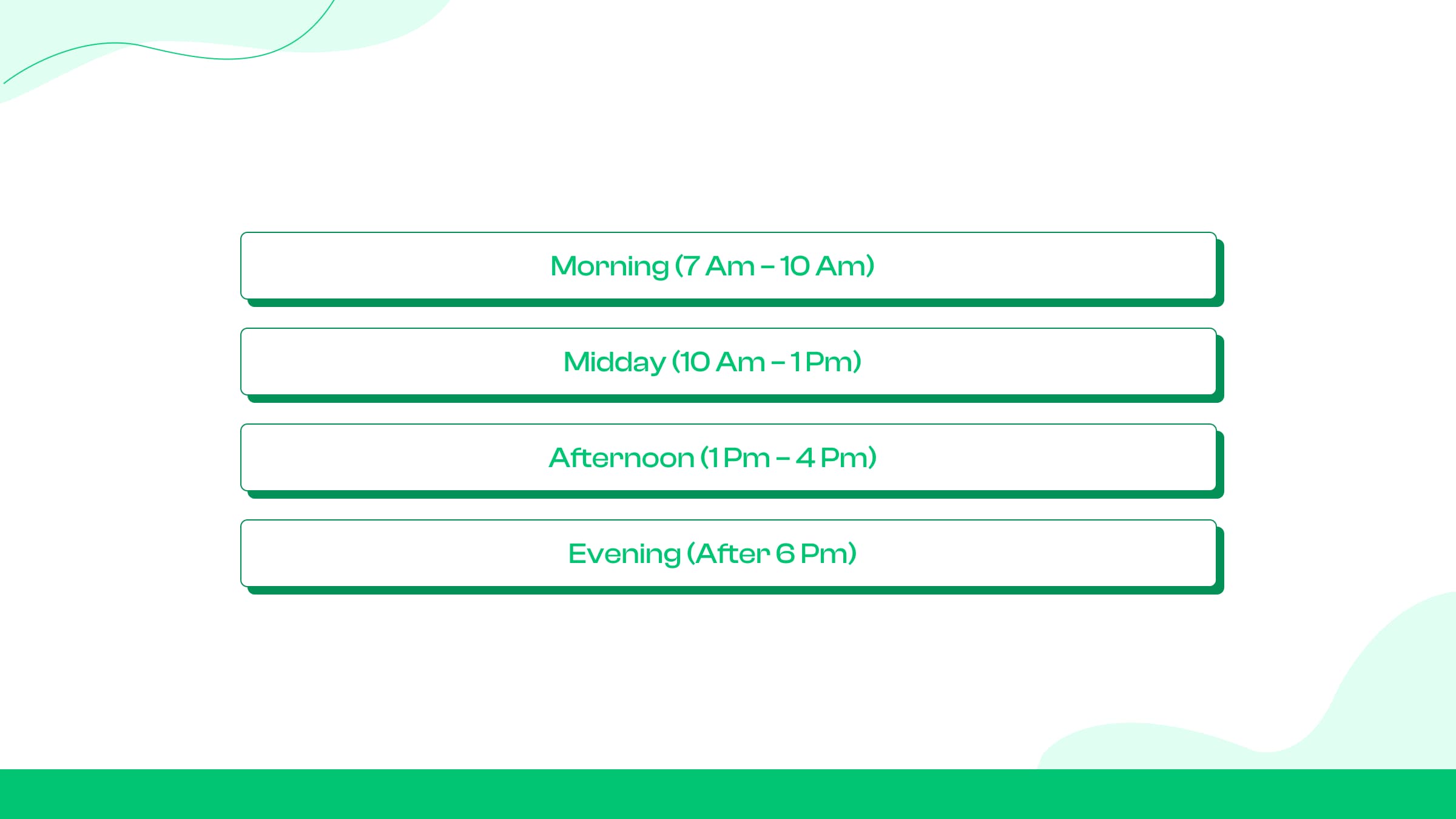
Instead of days, if you want to have a look at individual hours per day to know which window has the best engagement opportunities on a given day, you will find out certain patterns-
Morning (7 am – 10 am): Many users check LinkedIn during these hours while starting their usual workday, or during their first break. That said, in 2026 this block is no longer the clear peak it used to be — treat it as decent, not prime.
Midday (10 am – 1 pm): This particular window, especially late mornings through lunch breaks, comes with a high-traffic zone.
Afternoon (1 pm – 4 pm): Posting during the later work hours of the day can still yield significant engagement, particularly from users who have flexible work schedules or those who are in different time zones.Buffer’s 2026 data shows this afternoon block now performs especially well — in many cases better than the morning.
Evening (after 6 pm): After the sun sets, the window to post on LinkedIn becomes less dependable. However, evening engagement has risen in 2026, so for specific audience bases — shift workers, remote professionals, or cross-time-zone followers — late-hour posts are increasingly worth testing.
According to Buffer, engagement now runs strong from late morning into the evening on weekdays, a notable shift from the earlier morning-heavy pattern.
In short, the best window for posting on LinkedIn is from mid-morning to early afternoon. You can stretch the window to later hours a bit, or go earlier, in order to experiment with the specific engagement traits of your audience.
Best Time to Post on LinkedIn by Time Zone
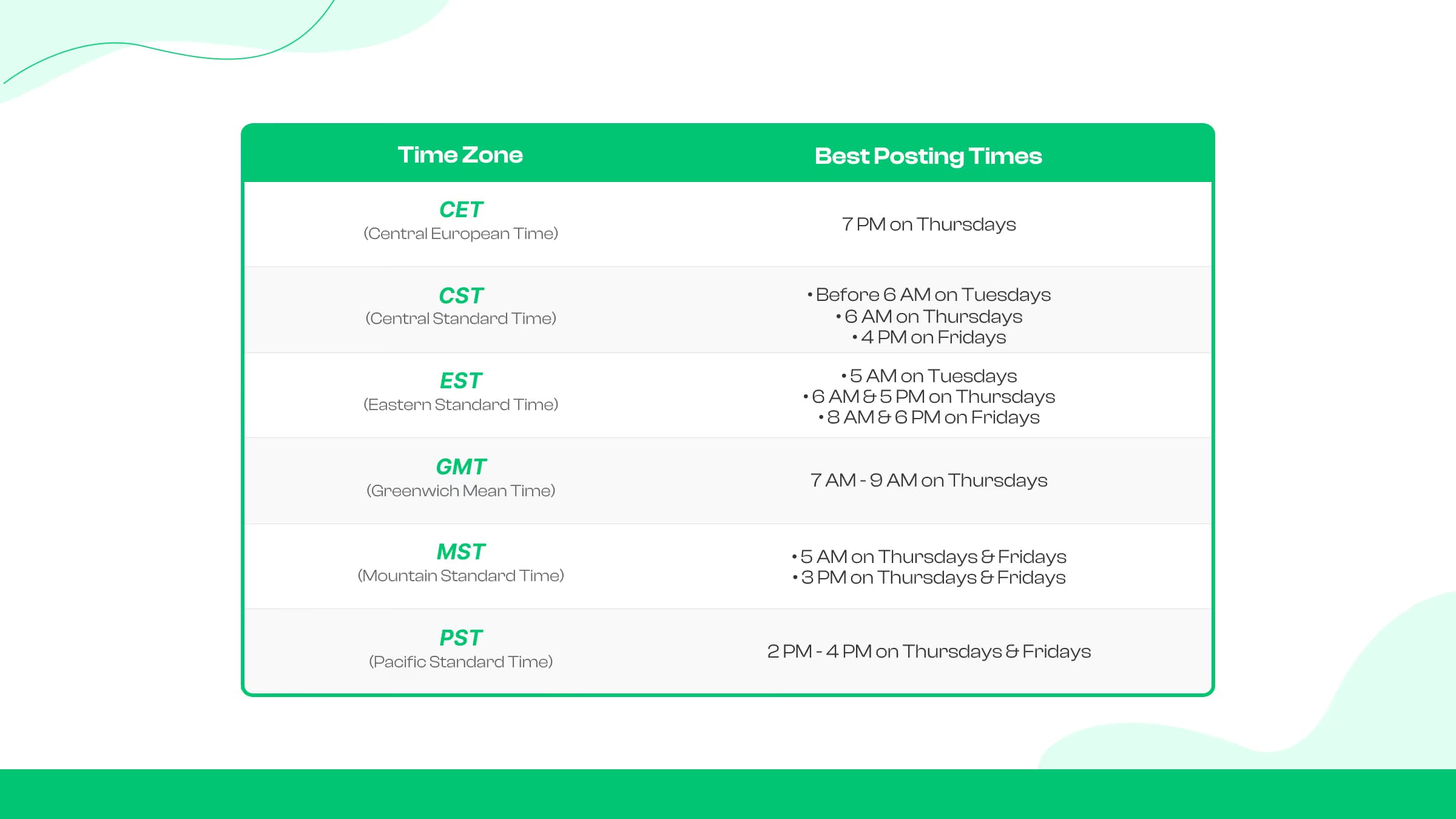
As LinkedIn is a global platform, posting times should also account for your audience’s locations and time zones. If your audience is mostly local, use the aforementioned window normally, based on your timezone.
However, if your audience is spread across multiple regions, it’s important to time your posts based on time zones. In that case, you can consider posting twice, such as morning in one zone, evening in another. You can also rotate peak times.
There are also tools like scheduling platforms, which will allow you to preview times in different zones, so you can ensure that your post goes online during “office hours” across regions. You can also try experimenting with the late evening slots, as they can align better with the morning window in another time zone, ultimately turning your evening post into a “prime time” post for your followers in other regions.
And when it comes to the audience engagement level across different time zones, its peaks can vary slightly based on local work habits and professional schedules. Here’s a breakdown of optimal posting windows by key time zones-
CET (Central European Time)
The best time to post on LinkedIn in the CET zone is 7 pm on Thursdays. This window marks the end of the workday, with users scrolling through updates before logging off.
CST (Central Standard Time)
In CST, engagement level is usually strongest during early mornings and late afternoons. Some good posting windows are-
Morning posts reach professionals when they are planning their day. Meanwhile, late Friday posts reach out to users who are looking for some pre-weekend networking and a reflection of the whole workweek.
EST (Eastern Standard Time)
The best times to post on LinkedIn in EST are:
Morning windows will help engage professionals who check updates before work, while evening windows capture after-work browsing.
GMT (Greenwich Mean Time)
In the GMT zone, the prime posting hour is 7 am to 9 am on Thursdays. This early-morning slot helps reach professionals who use LinkedIn while commuting to work, or before diving into their day. Such hours work great for B2B content and thought leadership posts.
MST (Mountain Standard Time)
The best times to post on LinkedIn in MST are:
PST (Pacific Standard Time)
In PST, the peak engagement window takes place during the afternoon hours, around 2 pm to 4 pm, on Thursdays and Fridays. This aligns with end-of-day breaks or when East Coast activity overlaps, helping content travel across time zones.
Tools to Determine Your Audience’s Active Hours
There are several tools you can use to find out the hours when your audience is the most active.
LinkedIn Analytics
LinkedIn’s native analytics for posts and company pages can help you figure out when your content gets more impressions or engagement. Just look for patterns over several weeks, and see which days in the week or hours in a day consistently outperform others.
If you have access to the “Best Time to Publish” or “Best Time to Post” features via LinkedIn or its management suite, try using their suggested windows. Some publishing dashboards integrate this.
Third-Party Tools
LinkedIn Posting Strategies by Content Type
Even if you manage to post on always on optimal posting windows, not all of your LinkedIn posts will perform the same way. And the timing for all kinds of posts shouldn’t be the same either.
Different content formats tend to attract engagement at different times, based on how users browse the platform during their day. If you can understand when and how to post your videos, polls, carousels, and long-form articles on LinkedIn, it will help you maximize your visibility and engagement.
Video Content
The timing for video posting is a bit different than regular text posts. Here are the details.
Best time for posting videos
One of the most engaging content formats on LinkedIn is videos. In fact, LinkedIn video posts generate roughly 3.2x more reactions than image-only updates, per Sprinklr’s 2026 data — so video is worth prioritising. However, figuring out the right time to post videos is a bit critical.
Videos posted during midweek, particularly on Tuesday through Thursday from 10 am–2 pm, attract the highest engagement. Users typically go on work breaks or take moments of mental downtime during these hours, so short-form video content feels digestible and refreshing to them.
Don’t post videos late in the evening or on weekends, as engagement rates see a decline around that time. LinkedIn’s audience usually shifts away from professional content during then.
Case studies of successful video posts
Short, subtitled videos under 90 seconds perform best on LinkedIn, and particularly when posted with a brief, compelling caption.
For example, B2B marketers like HubSpot and Canva often schedule video content, such as product explainers and testimonial clips, during mid-morning hours (11 am EST). Professionals are usually active and more likely to share or comment around these hours.
Polls and Surveys
Polls and surveys have their own most effective posting times. Let’s take a look.
Optimal posting time for interactive content
Polls, questions, and surveys thrive on quick participation. The interactive nature of such posts makes them ideal to be posted on Tuesday to Thursday mornings, around 8 am–11 am. However, engagement tends to drop after 3 pm, with professionals starting to disengage with their workday.
Remember one thing: if you post early, your poll will stay visible throughout the day. It will also allow LinkedIn’s algorithm to make the post reach more people, as responses keep increasing.
Engagement metrics to track
You can track several engagement metrics, like votes per hour, comment rate, and impressions, and evaluate if your polls are reaching the right audience.
LinkedIn Analytics and tools like Hootsuite or Sprout Social can help you discover when audience participation increases the most, so you can adjust your posting times based on that.
Articles and Long-Form Posts
Long-form content, such as articles or thought-leadership posts, performs best early in the morning, between 7 and 9 am, on weekdays. Tuesdays and Wednesdays, in particular.
Professionals’ morning routines often include reading industry insights before diving into work, and this timing helps tap into that phase.
There is a secondary engagement window for long-form posts, which is around lunchtime (12 pm–1 pm), when users take short breaks.
Also, try not to publish late in the afternoon, as fewer users are likely to click through and read the whole thing during those hours. For global reach, schedule your post based on your audience’s dominant time zone.
Carousels & Visual Content
Carousel posts, particularly those that use both visuals and storytelling, often enjoy a strong engagement level during midweek. The best window for making such posts is on Wednesdays and Thursdays, around 10 am–12 pm.
As these formats require a bit more attention from users, posting when people are alert and engaged helps increase their dwell time on the post. And it’s rewarded by LinkedIn’s algorithm.
Carousels also do well when posted early in the week for B2B audiences. Professionals are traditionally more receptive to educational and data-driven visuals during the productive part of their week, so posting such content then will help you with your engagement.
Text-Only Posts
Text-based short updates or reflections tend to perform best early in the morning (7–9 am) and late afternoon (4–6 pm) on weekdays. These windows align with commute hours or pre-/post-meeting browsing.
More recent data has reinforced the afternoon slot: text-only posts now perform reliably in the early-afternoon window too, and Wednesday remains a standout day for quick insights and updates.
Try to make your posts concise and relatable. Conversational posts, instead of overly polished ones, resonate more with the audience on LinkedIn.
Industry-Specific Posting Strategies
Audiences from different industries showcase different behaviors. Here are some of the timing strategies for several key sectors.
Tech Industry
Tech-related posts work best in early mornings, with higher engagement anticipated from 8 am to 10 am on Tuesdays and Fridays. Many tech guys check industry news and updates during these hours, before they get on with their day.
Mid-morning windows – around 10 am–noon – in midweek also tend to perform well, especially on Wednesdays and Thursdays, when projects and meetings are in full swing. So, this slot will bring success for you, especially if your content includes announcements, product updates, or trend analysis.
You can sometimes experience moderate engagement if you post during evenings, but early workday times are typically more reliable for this industry.
Education & Academia
For schools, universities, and academic organizations, the best windows to post on LinkedIn are mid-morning to early afternoon. For example, “Education & Schools” pages saw high engagement on Wednesdays and Thursdays between 10 am and 2 pm.
Mondays can also work well for the education sector, especially around 11 am-1 pm, when teachers and administrators plan the upcoming week or catch up after the weekend.
And don’t post very early in the morning or very late evenings, unless you have an active academic audience base at that hour, like international students in different zones.
Healthcare Sector
Usually, mid-morning to early afternoon on Tuesdays works best for posts regarding the healthcare sector, alongside Wednesdays and Thursdays, around 10 am–3 pm.
Wednesdays from 10 am to 12 pm, in particular, see high engagement for healthcare content. Public health updates, professional advice, or program announcements perform great at these hours.
Health-related content also performs decently in late afternoons (around 2-4 pm), especially on Thursdays. Healthcare workers may be found on breaks or between shifts during these hours.
Financial Services
Mornings work great for posts related to the finance sector. Wednesdays between 10 am–noon and Thursdays around 11 am-1 pm are among the best times for financial content.
Your finance-related content, such as market news or end-of-day wrap-ups, can do well during early mornings, before or just after the market opens. Content that provides financial insights or analysis tends to do well when posted before business hours or during lunch breaks.
Also, remember to avoid posting on weekends. Audiences from this sector tend to disengage from work outside business days.
Marketing & Agencies
Marketing and creative agencies generally find high engagement during mid-morning hours. For instance, 9 am-11 am on Tuesdays and Thursdays is especially effective, as marketers and others use these hours to plan or review campaigns. They often look for industry insights on LinkedIn while doing so.
Meanwhile, lunchtime windows, such as around 12 pm – 1 pm, can also show promise for marketing content, as marketers often look for inspirational content, case studies, or visual posts.
Users who work in agencies sometimes engage well later in the day, like around 5–6 pm. They tend to engage with content that reflects on the day, or focuses on thought leadership, or provides creative inspiration. You can try experimenting with these slots if your audience base represents this group.
Analyzing Engagement Metrics
Only intuition won’t help you optimize your LinkedIn strategy properly; you will need to figure out what has been working. You need to understand how LinkedIn’s algorithm works, leverage the analytics, and run experiments. Then you will gradually be able to adapt your content and timing based on what works best for your audience.
How the LinkedIn Algorithm Affects Post Visibility
It’s paramount to understand how LinkedIn decides what content to show and what not to. Posting at good times alone won’t save a weak post.
Quality filter or content classification: When you make a post on LinkedIn, the platform immediately assesses if the content is spam, duplicate, or low-quality. If a post fails to go past this initial screening, it can get suppressed.
Engagement testing (the “golden hour”): Right after a post is made, it appears on the feed of a small group of connections to see how they interact with the post (likes, comments, reaction time, dwell time). Within that early window, posts that attract meaningful interaction get rewarded with broader reach.
Relevance and network expansion: If your content manages to pass the initial test, LinkedIn uses a wide range of signals – such as audience interest, hashtags, how often users interact with your content, and topic relevance – to decide whether to push the post further and make it appear on the feeds of second and then third-degree connections.
Due to this chain of processes, early engagement, particularly in the first 30–60 minutes, carries a massive weight. That’s why timing, content quality, and prompt interaction matter so much.
However, it’s not really a piece of cake to maintain a substantial level of engagement in the first 30 to 60 minutes after you post on LinkedIn. No matter how good your timing or post quality is, there’s always a chance to fall short. But a little help from services like Socialplug can help you go a long way!
Worried about getting enough likes on your post? Try out Socialplug’s services today!
Not many people are commenting on your LinkedIn post? Socialplug can help with that, too!
Reaction numbers not up to your expectations? Don’t worry, we've got you here at Socialpug!
Not getting enough shares for your LinkedIn post? Say no more, Socialplug can take care of that as well!
Using Analytics to Refine Posting Times
Different metrics and audience insights can help you figure out the optimal time for posting on LinkedIn.
Tracking likes, comments, shares
Use your LinkedIn native analytics or page insights to monitor the performance of each post – which days and times bring higher impressions, likes, comments, shares, and clicks. (If you’re unsure how those two metrics differ, our guide on LinkedIn views vs impressions breaks it down.)
There are also different tools, like Sprout Social, that you can use to view engagement breakdowns, such as line charts of reactions, comments, or clicks. This will help you understand the engagement patterns over time.
Benchmark: Note the average level of engagement you get per post at different times and days for around 3 to 6 months.
Identify outliers and peaks: For instance, your posts may consistently get 30% more reactions than average on Wednesdays around 10 am. After finding out such peaks and outliers, experiment around these slots more intensely.
Using audience insights to improve reach
Apart from post metrics, also make sure to examine audience demographics and activity windows – the hours your followers are online. You can do so using LinkedIn analytics or third-party dashboards.
Tools like Hootsuite will allow you to view a “Best time to publish” feature per network, which will be personalized based on your audience. This is based on your engagement history and follower behavior.
Another such tool, Sprout Social, also allows users to test variables like post time, content type, and CTA language and see which combinations perform best over time.
Also, try using insights to mark "quiet zones". It refers to times or days when your content underperforms. Make sure to avoid them or use them only for evergreen posts.
Experimentation & A/B Testing
A structured and iterative approach will help you discover what truly works for your audience.
Define what you want to test. You can test what timing works best for you, or post format, or headline and CTA placement. Change one variable at a time.
Run the test for a sufficient period (at least several posts over 2–4 weeks) to smooth out anomalies.
Don’t just measure raw engagement; also find out the engagement rate by dividing your engagement by the number of impressions, and check the dwell time and click-through or follow-through actions.
Compare the results, and find out which posting slots perform consistently. Then iterate. Pick the winner timing, experiment with close windows again (e.g. test 8:30 am vs 9:00 am), and gradually lock in to your unique schedule.
Make sure to note down and document your test results so that you don’t repeat exercises or lose the insights.
Final Thoughts
Following a rigid schedule won’t help you master the best time to post on LinkedIn. It’s rather about understanding your audience and adapting to their habits. While data and different reports show that midweek is best for engagement, every industry and audience behaves differently.
The real key to mastering this lies in testing, observing, and refining your approach using insights from LinkedIn Analytics or other third-party tools. To make sure that you are enjoying the highest engagement on LinkedIn, you’ll have to combine smart and optimal timing with valuable and relevant content.
And while understanding audience behavior is important, it’s also necessary to have a significant number of connections and followers for your posts to enjoy high engagement. Yes, you can grow a large audience with consistent and quality posting over time, while excelling in your career, but some help from our services can do wonders in that regard.
Still don’t have a proper audience base, and worried about the number of connections and followers? You won’t have to go any further. Try out Socialplug’s services to get more followers and more connections right now!
Frequently Asked Questions
Do industries have different best posting times?
Yes. For example, tech and finance thrive on weekday mornings, while marketing sees higher midday engagement.
How often should I post on LinkedIn?
Posting 2–5 times a week helps maintain visibility without overwhelming your audience.
Are weekends good for posting on LinkedIn?
Not usually. Engagement drops on weekends as professionals disconnect from work.
Does the type of content affect the best posting time?
Yes. Videos perform best mid-morning to early afternoon, while articles and text posts work well early in the day. Video also earns far more reactions than image-only posts, so format matters as much as timing.
How can I determine my audience’s peak activity time?
Use LinkedIn Analytics or tools like Hootsuite, Sprout Social, or Buffer to track when your audience engages most.
What is the best time of day to post on LinkedIn?
Early mornings (7–9 am) and mid-mornings to early afternoons (10 am–2 pm) drive the most engagement.
What is the best day to post on LinkedIn?
Tuesday, Wednesday, and Thursday are the best days to post when professionals are most active and engaged.

0 Comments